

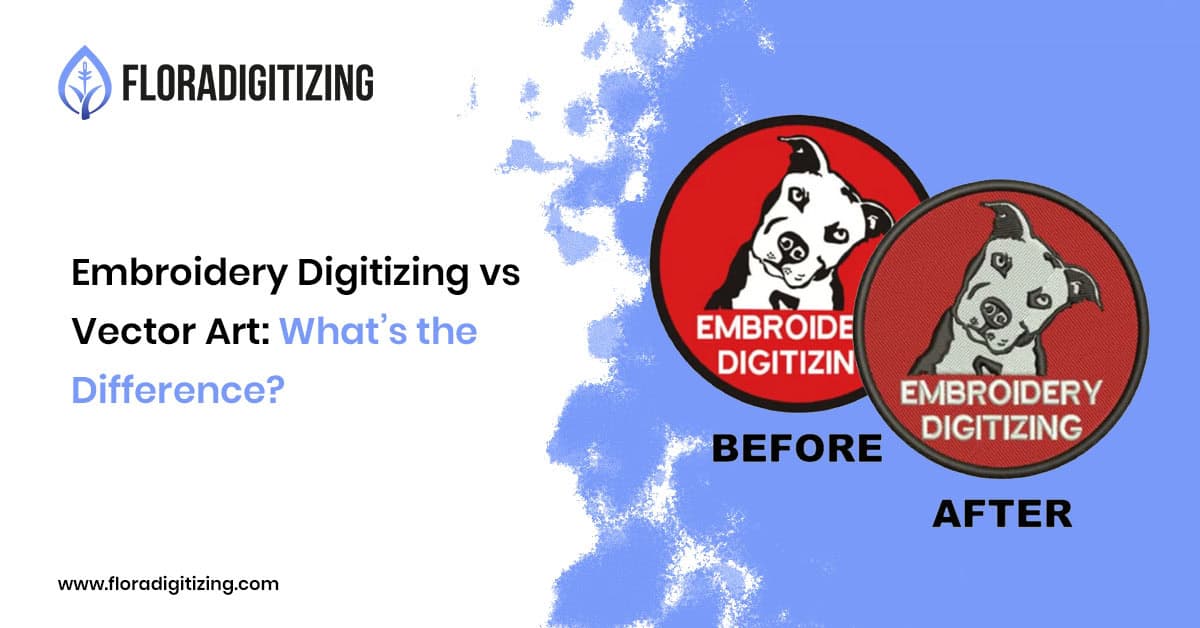
If you’re creating custom apparel, promotional products, uniforms, or branded merchandise, you’ve probably heard the terms embroidery digitizing and vector art. While they are often used together, they serve completely different purposes.
Many business owners mistakenly assume a vector file can be used directly for embroidery or that an embroidery file can be used for printing. Understanding the difference between embroidery digitizing vs vector art helps you avoid production mistakes, save time, and get better results for your brand.
In this guide, we’ll explain how both services work, when you need them, and why many businesses benefit from combining Embroidery Digitizing + Vector Art Services.
Quick Answer: Embroidery Digitizing vs Vector Art
Embroidery digitizing converts artwork into a stitch file that embroidery machines can read and sew onto fabric.
Vector art converts artwork into scalable graphic files that can be used for printing, branding, marketing, and design applications.
In Simple Terms:
- Vector Art = For Printing & Branding
- Embroidery Digitizing = For Embroidery Machines
A vector file cannot be embroidered directly, and an embroidery file cannot be used for graphic design or printing.
What Is Embroidery Digitizing?
Embroidery digitizing is the process of converting logos, images, or artwork into machine-readable embroidery files. Businesses looking for professional embroidery digitizing services can use production-ready files optimized for quality stitching and machine compatibility.
A professional digitizer manually creates stitch instructions that tell the embroidery machine:
- Where stitches begin and end
- Stitch direction
- Stitch type
- Density settings
- Underlay structure
- Thread sequence
Common embroidery file formats include:
- DST
- PES
- EMB
- JEF
- VP3
These files are known as machine embroidery files and are essential for producing clean, professional embroidery.
When Do You Need Embroidery Digitizing?
You need custom embroidery digitizing when creating:
- Company uniforms
- Polo shirts
- Caps and hats
- Hoodies
- Jackets
- Sportswear
- Custom patches
- Promotional apparel
If your logo or design will be stitched using thread, you need professional embroidery digitizing.
What Is Vector Art?
Vector art is artwork created using mathematical paths instead of pixels. Unlike JPG or PNG files, these files can be enlarged or reduced without losing quality. Additionally, vector formats remain sharp at any size, making them ideal for professional printing applications.
Common vector formats include:
Unlike JPG or PNG files, vector files can be enlarged or reduced without losing quality.
Common vector formats include:
- AI
- EPS
- SVG
Professional vector art services help businesses create clean, scalable artwork suitable for:
- Screen printing
- Signage
- Promotional products
- Branding materials
- Marketing collateral
- Packaging
- Vehicle graphics
Because vector graphics remain sharp at any size, they are the preferred format for professional printing.
Why Apparel Brands Need Both Embroidery Digitizing and Vector Art Services
Many apparel brands require both Embroidery Digitizing + Vector Art Services to maintain consistent branding across multiple products.
For example:
A clothing brand may use:
- Vector files for screen-printed t-shirts
- Embroidery files for hats and uniforms
- Vector artwork for packaging and marketing materials
- Digitized files for patches and embroidery production
Using both services ensures your logo looks professional regardless of where it appears. As a result, businesses can maintain brand consistency across multiple products.
This approach is especially important for:
- Apparel brands
- Embroidery shops
- Print shops
- Promotional product companies
- Corporate branding agencies
Embroidery Digitizing vs Vector Art: Side-by-Side Comparison
| Feature | Embroidery Digitizing | Vector Art |
| Purpose | Embroidery Production | Printing & Branding |
| Output File | DST, PES, EMB | AI, EPS, SVG |
| Used For | Embroidery Machines | Printers & Designers |
| Editable | Limited | Fully Editable |
| Scalable | Requires Re-Digitizing | Infinitely Scalable |
| Production Method | Thread & Stitches | Ink & Graphics |
Embroidery File vs Vector File: Understanding the Difference
A common question businesses ask is:
What is the difference between an embroidery file vs vector file?
A vector file contains:
- Shapes
- Curves
- Colors
- Editable design elements
An embroidery file contains:
- Stitch instructions
- Needle penetrations
- Thread paths
- Density settings
Because embroidery machines don’t understand graphic shapes, they require specially digitized files.
This is why vector art for embroidery machines must first go through the digitizing process before embroidery production can begin.
Do I Need Vector Art for Embroidery?
Short Answer: No, but it helps.
One of the most common questions businesses ask is whether vector artwork is required for embroidery. In most cases, designs can be digitized from several file types, including:
Do I need vector art for embroidery?
You can digitize from:
- PNG files
- JPG files
- PDFs
- Screenshots
However, vector artwork provides:
- Cleaner design lines
- Better accuracy
- Faster digitizing
- Improved stitch quality
This is why many embroidery shops prefer AI, EPS, or SVG files whenever possible.
Logo Digitizing vs Vector Conversion
Many people confuse logo digitizing vs vector conversion, but they are completely different services.
Logo to Vector Conversion
Converts logos into:
- AI
- EPS
- SVG
Used for:
- Printing
- Marketing
- Branding
Logo Digitizing Services
Converts logos into:
- DST
- PES
- EMB
Used for:
- Embroidery machines
- Uniforms
- Hats
- Patches
- Apparel decoration
If your goal is to convert logo to embroidery file, you need embroidery digitizing rather than vector conversion.
Why Embroidery Machines Can’t Read Vector Files
Even though vector files contain clean artwork, embroidery machines cannot use them directly.
Embroidery machines don’t understand:
- Shapes
- Curves
- Colors
They only understand:
- Stitches
- Thread paths
- Needle movements
- Stitch density
A digitizer must manually translate the artwork into embroidery instructions.
This process is what separates professional digitizing services from simple file conversion.
Best File Format for Embroidery Digitizing
When preparing artwork for embroidery, some file formats work better than others.
Recommended Formats
- AI
- EPS
- SVG
These files provide clean artwork and simplify both vector art conversion and embroidery digitizing.
Acceptable Formats
- PNG
- JPG
- PSD
While these files can still be digitized, they may require additional cleanup and embroidery file conversion before production.
Real-World Example
Imagine a company launching a new logo.
Step 1: Vector Art Creation
First, the logo is converted into:
- AI
- EPS
- SVG
These files are used for:
- Website graphics
- Business cards
- Packaging
- Screen printing
Step 2: Embroidery Digitizing
Next, the same logo is digitized into:
- DST
- PES
These files are used for:
- Hats
- Jackets
- Uniforms
- Custom patches
This is a perfect example of how both services work together while serving different production purposes.
Which Service Should Your Business Choose?
Vector Art If:
- Scalable artwork is required for your business
- Planning a screen printing project
- Creating marketing and branding materials
- Looking for professional logo recreation
Embroidery Digitizing it:
- Producing embroidered apparel
- Creating custom patches
- Decorating hats and caps
- Requiring machine embroidery files for production
Both If:
- Running a clothing brand
- Selling promotional products
- Managing corporate branding projects
- Needing both printing and embroidery solutions
For most businesses, combining both services provides the best long-term branding solution.
Need Professional Embroidery Digitizing or Vector Art Services?
Whether you need custom embroidery digitizing, logo digitizing services, vector art conversion, or raster to vector conversion, Flora Digitizing provides production-ready solutions tailored to your business needs.
Our services include:
- Professional embroidery digitizing services
- Vector art services
- Logo to vector conversion
- Embroidery file conversion
- Machine embroidery files
- Custom patch design support
We help apparel brands, embroidery shops, print businesses, and promotional product companies achieve professional results with fast turnaround and reliable quality.
Frequently Asked Questions
Embroidery digitizing creates machine-readable stitch files, while vector art creates scalable graphic files used for printing and branding.
Can a vector file be used for embroidery?
No. A vector file must first be digitized into an embroidery file format such as DST or PES.
Do I need vector art for embroidery?
Not necessarily, but vector artwork improves accuracy and often results in better embroidery quality.
What is logo digitizing vs vector conversion?
Logo digitizing creates embroidery files for machines, while vector conversion creates scalable artwork for printing and branding.
What is the best file format for embroidery digitizing?
AI, EPS, SVG, and PDF are generally the preferred formats because they provide clean, scalable artwork.
Yes. Professional vector art services for screen printing create clean, scalable artwork ideal for high-quality printing applications.
Final Thoughts
Understanding embroidery digitizing vs vector art is essential for businesses involved in apparel decoration, branding, printing, and promotional products.
While vector artwork helps create professional branding assets, embroidery digitizing converts designs into stitch-ready files for embroidery machines. Consequently, businesses can maintain consistent branding across uniforms, custom patches, promotional products, and embroidered apparel.
Instead of relying on a single solution, many apparel brands, embroidery shops, and print companies use both services to achieve better production results. Furthermore, combining vector artwork and embroidery digitizing helps improve workflow efficiency while reducing costly production errors.
At Flora Digitizing, we provide professional embroidery digitizing services USA and high-quality vector art solutions designed for businesses that demand accuracy and reliability.
Ready to get started? Explore our Embroidery Digitizing Services and Vector Art Services to transform your artwork into professional files built for long-term production success.